
How to Check Criminal History in Bridgeport
Start by naming the record. Bridgeport Police supplies city incident and arrest reports. Connecticut Superior Court supplies filed charges, docket events, and dispositions. CT DOC reports current state custody. SPBI and CCHRS supply official Connecticut conviction-history products. These sources update on different schedules, so one result should not be treated as the whole Bridgeport criminal history.
- Ask BPD Records for the police report or local arrest file.
- Give the file number or precise incident details and confirm readiness.
- Search the Judicial Branch for the filed case and disposition.
- Use CT DOC for present state custody, not a county jail roster.
- Use SPBI or CCHRS for an official statewide conviction history.
Bridgeport Police Records at 300 Congress
The Bridgeport Police Records Division is at 300 Congress Street. Call 203-581-5270 on weekdays from 9 a.m. to 5 p.m., excluding holidays. It maintains incident, accident, stolen or recovered vehicle, arrest-warrant, arrest, and local sex-offender records. The front desk is 203-581-5100 and the booking area is 203-581-5141. A focused request gives requester contact, file number, date, time, location, involved names, exact record or media, and preferred delivery.
View the official Bridgeport Police source.
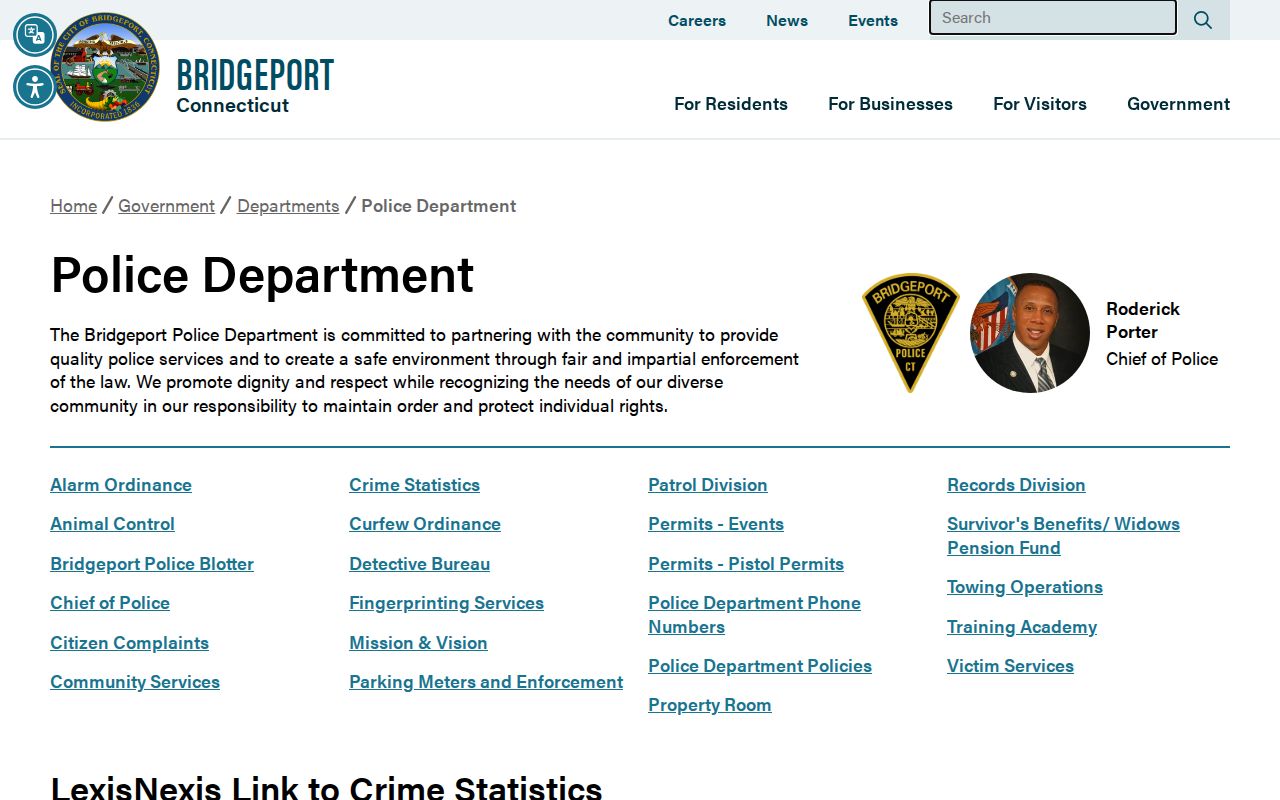
Check the live city page before travel because forms and office procedures can change.
The Bridgeport Police Department
Paper copies cost $0.50 per side. In person is cash. Mail requests need the complete file number, a money order, and a self-addressed stamped envelope; BPD does not accept report requests by fax. Staff may confirm readiness but do not provide report details by phone. Approval may take five days, and the page advises seven to ten working days for pickup.
The city FOI fallback accepts written requests by mail, email, fax, drop-off, and MyCustHelp. The vendor portal is session-gated, so requesters should follow its current prompts rather than rely on invented fields. Accident reports route from BPD to LexisNexis BuyCrash after a five-business-day wait and carry an added vendor fee.
Getting a Bridgeport Police Arrest Record
BPD states that an arrest-related incident report is not released until all charges are adjudicated. Victims may work through the court victim advocate, while an accused person may use counsel or the public defender. Juvenile reports require Youth Bureau commander approval, and sexual-assault reports require Detective Bureau commander approval.
Connecticut FOIA does not make every investigation page public. Section 1-215 protects access to core adult arrest information, while §1-210 exemptions can shield active-investigation, witness, victim, juvenile, and other restricted material. Ask for a written explanation when records are withheld.
Arrests and Bookings in Bridgeport
BPD processes people in a police holding facility, not a county jail. Its policy permits no more than 72 hours, excluding weekends and holidays, before release or transport for arraignment. Periodic BPD blotters omit juveniles and warn that an arrest is not proof of guilt. They are snapshots, not a complete live custody roster.
After court presentment, custody may move to CT DOC. Bridgeport Correctional Center at 1106 North Avenue is a state-operated level-4 facility. Its name does not make it a Fairfield County jail. The statewide locator follows later DOC placement and may show an accused person who has not been convicted.
When Bridgeport CT DOC Shows Accused
Connecticut's unified correctional system holds both pretrial accused people and sentenced people. An “Accused” result does not establish guilt. Read it beside the Judicial docket for the pending charge and assigned court. The local chain can run from BPD booking, to marshal and court presentment, then to DOC commitment. Each stage has its own custodian and record.
A fast transfer can make a booking-area call stale. Use the Fairfield County arrest-history guide for county-scale custody detail, but return to BPD and the assigned Bridgeport court for the event itself.
Bridgeport Superior Court Records
Bridgeport has no municipal criminal court. Connecticut abolished county government in 1960 and later consolidated trial jurisdiction in Connecticut Superior Court. G.A. 2 and Fairfield Judicial District sessions handle Bridgeport criminal business, based on geography and case level.
| Court system | Connecticut Superior Court G.A. and Judicial District sessions. |
|---|---|
| G.A. 2 | 172 Golden Hill Street; arraignments and most local criminal matters. |
| Fairfield J.D. | 1061 Main Street; Judicial District business and serious felony work as assigned. |
| Lookup | Pending, conviction, docket-number, daily-docket, and warrant tools. |
| File | Charges, pleas, motions, disposition, sentence, and filed documents as applicable. |
Bridgeport G.A. 2 Versus Fairfield J.D.
The labels are not interchangeable. G.A. 2 is at 172 Golden Hill Street, with chief clerk 203-579-6568. Fairfield J.D. is at 1061 Main Street, with clerk 203-579-6527 and Public Information Desk 203-579-6193. Both list offices from 9 a.m. to 5 p.m. and doors at 8:30 a.m.
Portal codes differ too: F02B identifies Bridgeport GA2 and FBT identifies Bridgeport JD. Verify the docket and current Judicial Directory before visiting. Never call 1061 Main Street “GA2.” A certified disposition comes from the clerk where the case was heard.
The Judicial search supports pending and conviction searches by defendant or docket, daily dockets, and a warrant view. It requires a last name and accepts a first initial, birth year, year range, court, and category. No result is not reliable warrant clearance because sealed material and timing limits can keep data off the public display.
Where Bridgeport Records End Up
A BPD arrest starts with city paperwork. Prosecutors choose the filed charge, Superior Court records the case and disposition, and qualifying information reaches the State Police Bureau of Identification. An arrest charge and a filed charge can differ, so neither should be silently substituted for the other.
Record flow: Bridgeport Police Department › Connecticut Superior Court › State Police Bureau of Identification
Use BPD for the police narrative, the assigned clerk for the case file and certified disposition, and SPBI for official Connecticut conviction history. A public docket is not a complete adult history, and a name-based SPBI search is not fingerprint-confirmed.
Bridgeport Charges and State Prosecution
The Bridgeport State's Attorney district covers Bridgeport, Easton, Fairfield, Monroe, Stratford, and Trumbull. State's Attorneys are appointed rather than county-elected. The official 2024 district report says BPD accounted for 52 percent of district arrests. That is workload distribution, not a conviction rate or personal risk measure.
View the official Division of Criminal Justice source.
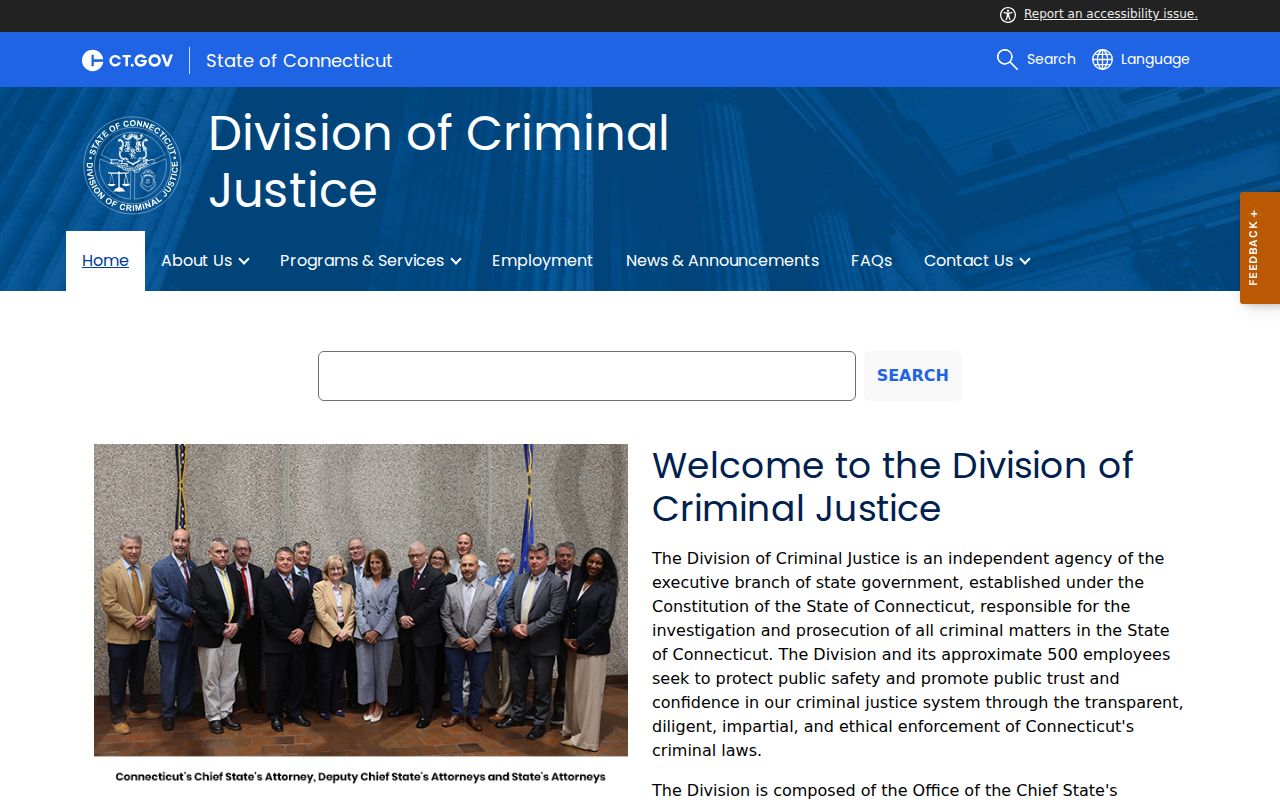
Prosecutor and court files remain distinct even when they concern the same Bridgeport matter.
Archived Bridgeport Dockets and City Context
Bridgeport's role as Connecticut's largest city and a principal Fairfield Judicial District venue makes it the closest thing Fairfield County has to a criminal-record hub, but Bridgeport is not a county seat. County government was abolished, and the modern record path follows state courts, state correction, state prosecution, and municipal police custody. That structure explains why a search can involve several Bridgeport addresses without any county clerk, sheriff, or county jail.
The city's own growth also shaped this geography. Bridgeport became a borough in 1800, a town in 1821, and a city in 1836. Harbor trade, rail links, industrial growth, and annexations expanded both the city and its public institutions. The “Park City” name reflects its parks and shoreline, while P. T. Barnum's service as mayor is part of its civic history. The castle-like Golden Hill courthouse, designed by Warren R. Briggs in 1888, is historic context for the present G.A. 2 location, not a separate municipal court system.
For an older Bridgeport prosecution, begin with the Judicial public search and note the docket prefix, date, and courthouse. Then contact the clerk where the matter was heard or the Judicial Records Center if the public display has aged off. Online conviction information has time limits, and an old court location or portal dropdown does not necessarily describe current assignment. A clerk can explain the access route for a non-erased file and the method for ordering an available copy or certified disposition. If the case was erased, ordinary public retrieval is no longer an alternative route.
This archive path differs from a BPD records request. The police report documents the local investigation and arrest, while the court file documents charges as filed, pleas, motions, programs, disposition, and sentence. Keeping those sources separate helps a Bridgeport reader spot a reduced or dismissed charge instead of repeating the first allegation as the final outcome.
Public Access Rules for Bridgeport Records
The Connecticut Freedom of Information Act applies to BPD, subject to record-specific limits. Core adult arrest facts fall under §1-215, while §1-210 contains exemptions. Erased cases under §54-142a generally cannot be disclosed or acknowledged. Juvenile, victim, sealing, and active-investigation rules may narrow access.
Key Statutes:
Connecticut Freedom of Information Act sets the public-record framework.
C.G.S. §1-215 identifies public adult arrest information.
C.G.S. §54-142a governs qualifying erasure and nondisclosure.
Review the official Connecticut FOIA statutes.
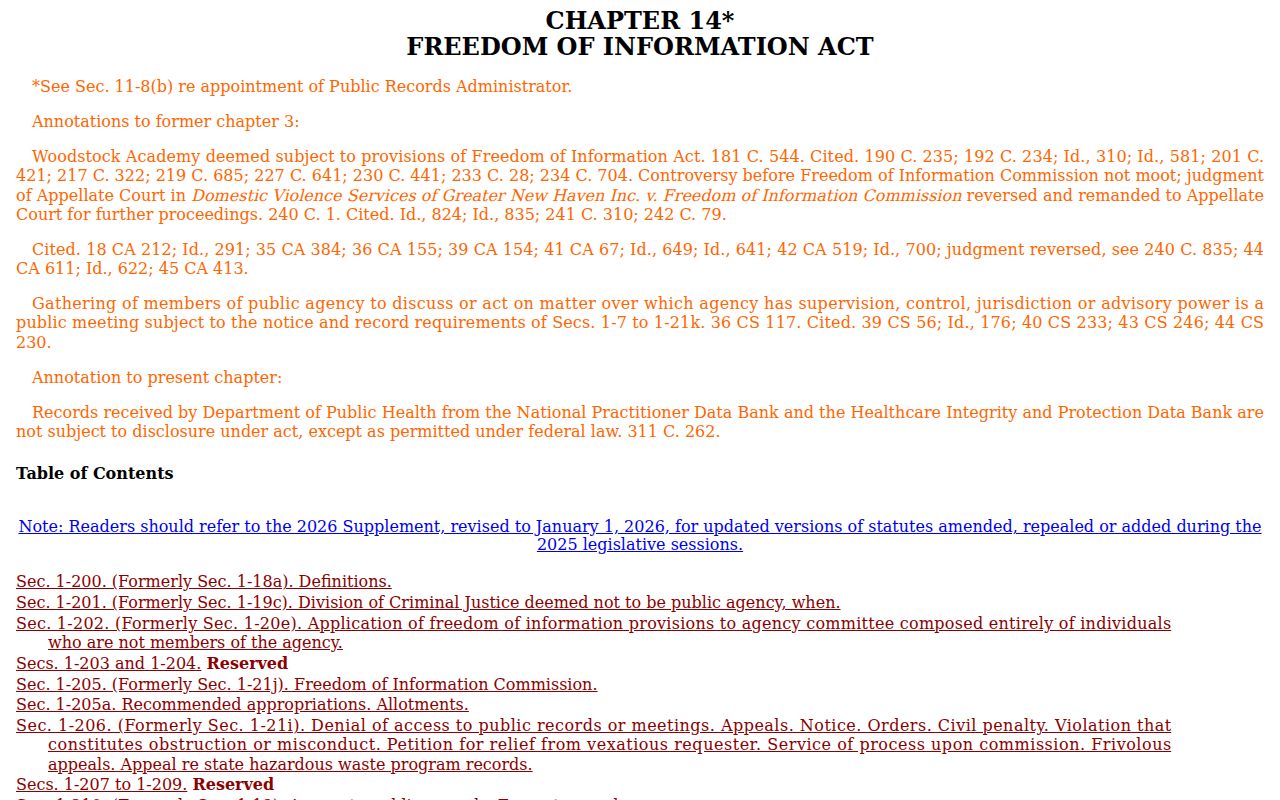
Identify the desired file narrowly and ask for the legal basis when access is denied.