
How to Check Criminal History in Stamford
A useful Stamford search starts by defining the question. The Stamford Police Department holds its own incident, arrest, collision, audio, video, CAD, and 911 material. The Connecticut Judicial Branch holds the criminal docket and court file. The Department of Correction reports current state custody, and the State Police Bureau of Identification supplies official Connecticut conviction-history products. No one result replaces the rest.
- Ask Stamford Police Records Retention for the local report, using the incident number when known.
- Identify the exact report, video, CAD, 911, or collision item and give its date, time, place, and incident type.
- Search the Judicial Branch criminal docket, then contact the assigned Stamford clerk when a complete or certified court file is needed.
- Use the statewide DOC locator for current custody after transfer, not a supposed Fairfield County jail list.
- Request an SPBI name-based or fingerprint-supported history when the reader needs an official Connecticut conviction record.
The broader Fairfield County criminal history overview explains why these state and city channels replace county government offices. Stamford records should never be routed to an invented county sheriff, county clerk, or county jail.
Stamford Police Records Retention Unit
The Stamford Police Records Retention Unit is the direct source for a Stamford Police report. Its public contact is 203-977-4409 and spdrecords@stamfordct.gov. An email should give the report number or requester name, incident date and time, location, and incident type. The unit also notes that it can correspond by email in more than one language.
Counter service at 725 Bedford Street is offered Tuesday and Thursday from 11 a.m. to 7 p.m., subject to staffing. Most reports are estimated at three to five business days. Arrest-report release can depend on the court status, so the passage of a few days does not guarantee that every part of a Stamford file is available.
Paper copies cost $0.50 per page. Collision reports cost $8.50 through the stated channel. Payment is by check to the City of Stamford, with no cash accepted. Audio or video requests are priced by invoice and collected later. These distinctions matter because asking for “the whole file” can mix records with different review, redaction, and delivery work.
The Stamford Police Department
Stamford Police creates the municipal record when its officers respond, investigate, or make an arrest. That record can contain the event narrative and agency data, but it does not establish guilt. The department may withhold or redact material protected by Connecticut law, such as parts of an active investigation, juvenile material, or details that identify protected victims and witnesses.
A narrow request is easier to route. State the incident number if known, identify whether the request concerns a report, recording, CAD log, or 911 record, and ask for electronic delivery when practical. The police custodian supplies the Stamford event record. It does not issue a certified court disposition or a complete statewide conviction history.
Stamford Video and 911 Records
Video, dispatch data, and 911 audio should be requested as separate Stamford records rather than assumed to be attachments to a paper incident report. Name the desired medium, the event date and time, location, and report number. Audio and video are invoiced after review, which differs from the fixed per-page charge for paper.
Separate treatment also reflects different legal concerns. A written arrest record may be public while a recording contains private medical speech, witness information, or investigative detail that requires redaction. Requesters can ask the Stamford custodian for any reasonably segregable public portion if the full item cannot be released.
Arrests and Bookings in Stamford
Stamford Police has a municipal lockup for processing. It is not a Fairfield County jail. A person may be processed by the city and presented in court; if bond is not met after arraignment and a commitment follows, custody moves into the unified Connecticut Department of Correction system. That sequence creates records at several agencies.
Stamford has no verified complete public city arrest blotter in the official sources reviewed. For recent local activity, use the Records Retention email or counter and the Judicial Branch lookup. For current state custody after commitment, use CT DOC. The official locator can describe a person as “Accused,” so a match is not proof of conviction.
For full treatment of agency reports, custody timing, and court follow-through, the Fairfield County arrest history page follows the record beyond local processing.
Stamford Criminal Cases at Hoyt Street
Current Stamford criminal business routes through Stamford-Norwalk Judicial District and Geographical Area 1 at 123 Hoyt Street, Stamford. GA1 takes arraignments and most criminal matters based on where the alleged offense occurred. Serious felony work can proceed in a Judicial District session. Both are sessions of the Connecticut Superior Court.
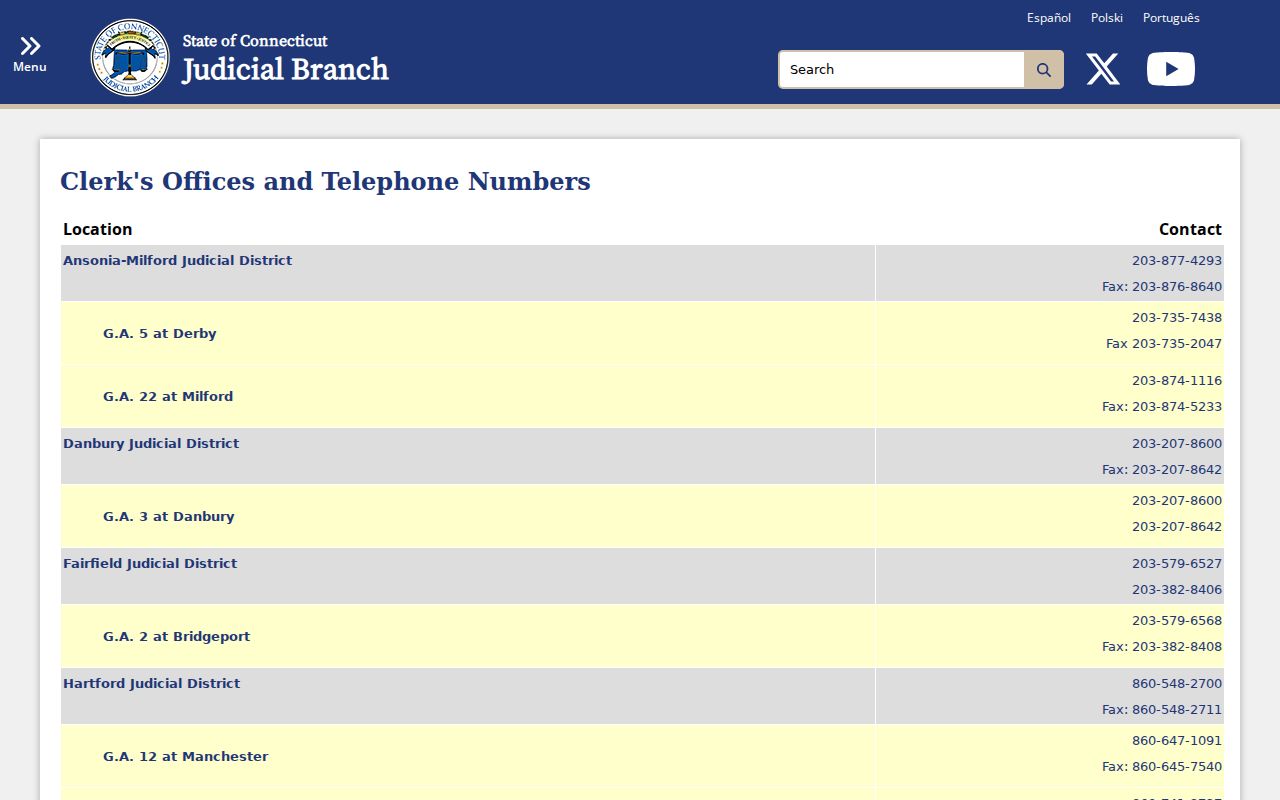
The Stamford-Norwalk clerk public-information number is 203-965-5307. The Court Service Center is on the fourth floor at 203-965-5328. GA1 offices generally run from 9 a.m. to 5 p.m., with building doors opening at 8:30 a.m. Judicial marshal screening applies, so access rules for phones, cameras, food, weapons, and recording devices should be confirmed before a visit.
The Judicial Branch clerk directory shows how to reach the correct clerk. The captured directory view reinforces that Stamford court contacts are part of a statewide branch, not a Fairfield County clerk system.
Use the docket location shown in the live case result before requesting a certified disposition or file copy.
Stamford Municipal Court Records
Stamford does not operate a municipal criminal court. Connecticut ended the former state, county, and municipal court layers and consolidated trial work in Superior Court. City ordinance, motor vehicle, misdemeanor, and felony matters that become criminal cases therefore do not sit in a separate Stamford municipal docket.
| Court Name | Connecticut Superior Court, Stamford-Norwalk J.D. and G.A. 1 |
|---|---|
| Case Types Heard | Arraignments and criminal matters assigned by offense location; serious felony work may proceed in the Judicial District session |
| Case Lookup Channel | Judicial Branch pending, conviction, docket-number, and daily-docket searches; clerk or Records Center for fuller files |
| What the Docket Shows | Party and docket data, charges, dates, court location, events, disposition, and sentence when publicly available |
| Copies & Fees | Email may be free when an archived file is small enough; pickup, paper, and certification can carry current Judicial Branch charges |
A court file can include a warrant affidavit, complaint, uniform arrest report, charging information, plea paper, program documents, mittimus, probation orders, receipts, and a transaction sheet. Not every Stamford file contains every item.
Stamford Report Versus State Docket
The Stamford report and Hoyt Street docket answer different questions. Police describe the agency event, while the court records the filed case and its path. A person may appear in one system before the other, and a police event may not produce a filed charge. Likewise, a court disposition does not turn every investigative page into an unrestricted public record.
Names alone can also produce a weak match. A Stamford police request works best with the local report number, event date, location, and record type. A Stamford court search can be narrowed with birth year, first initial, court location, or the exact docket number. Those fields help separate people with similar names without implying that any result belongs to the person being researched.
| Record | Best source | Main use |
|---|---|---|
| Incident or arrest report | Stamford Police Records Retention | What the city agency documented |
| Pending or disposed case | Judicial Branch and Hoyt Street clerk | Charges, events, result, and sentence |
| Current custody | Connecticut DOC | State confinement status and location |
| Official conviction history | DESPP SPBI through CCHRS or approved form route | Connecticut repository response for the stated purpose |
For older disposed Stamford files, email SuperiorCourtRecordsCenter@jud.ct.gov with the case name and docket number. Retrieval is expected in one or two business days. Email delivery may be free when file size permits; pickup can involve copy or certification fees and identification.
Where Stamford Records End Up
A Stamford arrest begins with the city agency, but later facts move through state systems. The prosecutor and court record charges and dispositions. Fingerprints and reporting identifiers help SPBI associate the event with the Connecticut repository record. A commitment after arraignment shifts custody information to DOC.
Record flow: Stamford Police Department › Connecticut Superior Court at Stamford › Connecticut DESPP State Police Bureau of Identification
Recent activity is often best checked with Stamford Police and the pending-case search. A final result belongs in the court file, while an official conviction-history request uses SPBI. Each source can update on a different schedule, so conflicts should be resolved with the originating agency and a certified disposition.
Stamford Adult Probation Records
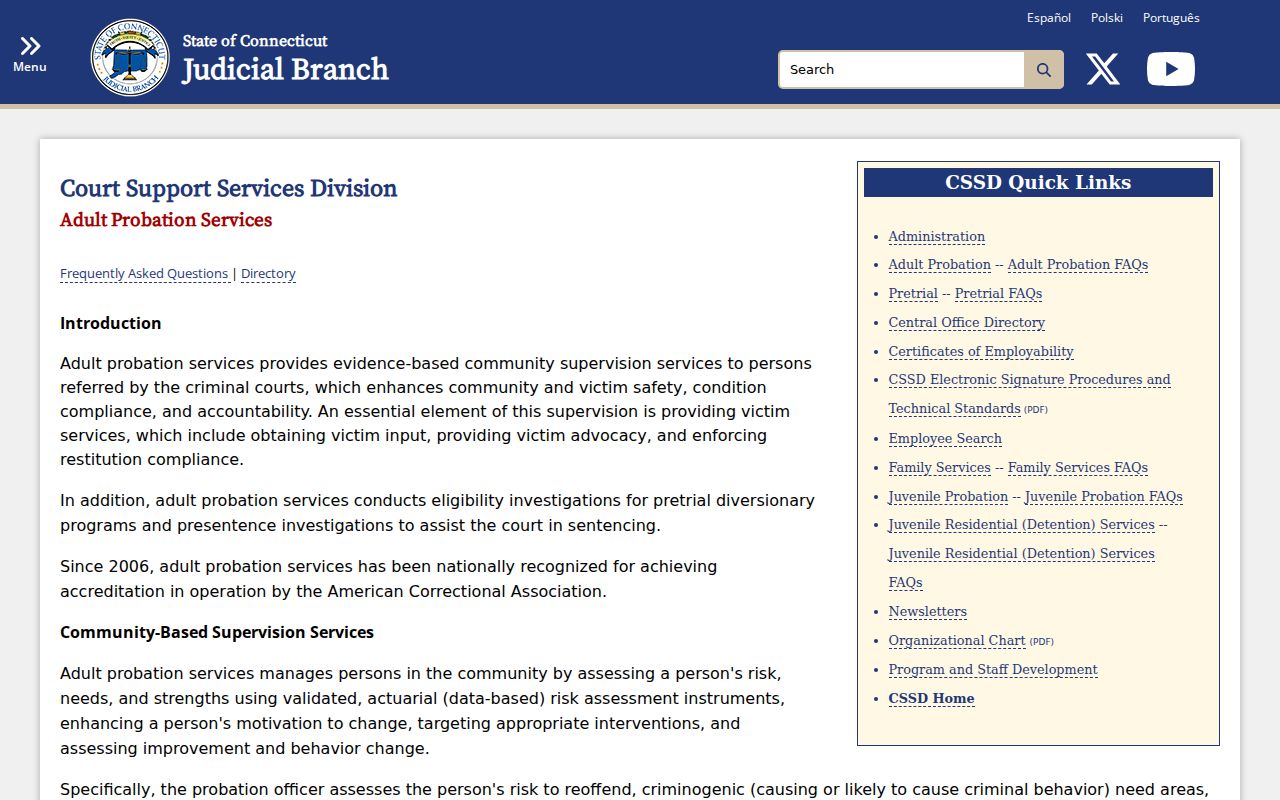
Adult probation is a state Judicial Branch function, not a city or county department. The GA1 Adult Probation office at Hoyt Street can be reached at 203-965-5230. Public docket data may show a probation order, but supervision records and private case-management details are not automatically open merely because the sentence is public.
The Judicial Branch Adult Probation source explains the statewide structure serving Stamford. Its captured page helps distinguish a sentence administered through Court Support Services from a city police record.
Ask the Hoyt Street clerk for the public judgment or probation order rather than treating the probation office as a general background-record counter.
Reading Stamford Criminal Dispositions
A Stamford docket can end with a guilty finding, dismissal, nolle, program result, or other status. A nolle means the prosecutor declined to proceed at that point; it is not a conviction. Under Connecticut erasure rules, an acquittal or dismissal erases after the appeal period, while a nolle ordinarily erases after thirteen months if statutory conditions are met.
Public online conviction information generally remains for no more than ten years after sentencing, or for a shorter period under the applicable court rule, and can be removed about a month before that endpoint. Youthful-offender, juvenile, infraction, violation, and erased matters have separate limits. Absence from a public screen therefore does not prove that no historical event ever existed.
A Stamford reader who finds a wrong or stale repository entry should gather the certified Stamford disposition and use the SPBI challenge route under §54-142l. Correcting the city report, court docket, and state history may require contact with more than one custodian because each Stamford-related system keeps a different part of the record.
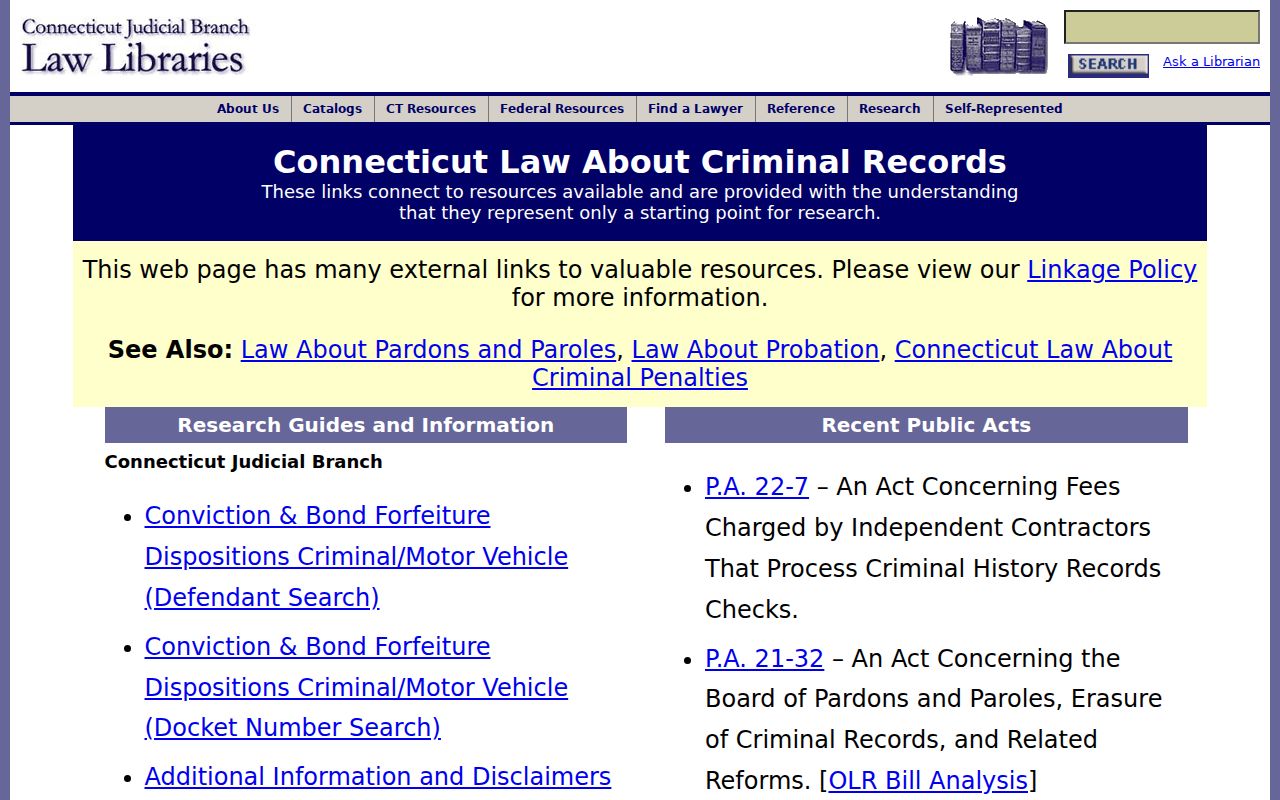
The Connecticut Judicial Branch criminal law library guide supplies official research paths for Stamford criminal law and procedure.
For a case-specific answer, obtain the public docket and, when needed, a certified disposition from the court that heard the matter.
Public Access Rules for Stamford Records
Connecticut FOIA governs access to Stamford executive-agency records. It generally permits prompt inspection during regular hours and copies of nonexempt records. Court records follow Judicial Branch access rules and constitutional principles instead of being processed as ordinary city FOIA demands. That difference determines whether a request goes to Stamford Police or the Hoyt Street clerk.
Key Statutes:
Connecticut General Statutes §1-210 gives access to public records while preserving stated exemptions.
Connecticut General Statutes §1-212 governs copies, electronic formats, and lawful copy charges.
Connecticut General Statutes §1-215 protects access to the core adult arrest record despite specified investigative exemptions.
If Stamford withholds part of a police file, ask for the cited exemption and all reasonably segregable public portions. Section 1-206 supplies the Freedom of Information Commission appeal route. Erased, juvenile, protected-victim, and active investigative material can remain unavailable even when the basic adult arrest fact is public.