
How to Check Criminal History in Fairfield County
A Fairfield County records check starts by deciding which fact is needed. A Judicial Branch docket gives a no-cost case overview. A municipal police report describes one agency event. The Connecticut Department of Correction reports current state custody, while the State Police Bureau of Identification supplies the official Connecticut conviction-history product. None is a universal substitute for another.
Gather a full legal name, spelling variants, date of birth or birth year, the town where the event occurred, and any docket or incident number. A common name can return more than one person. Match location, dates, and identifiers before treating a Fairfield County criminal record as connected to the intended subject.
- Search the Judicial Branch pending or conviction view for a no-cost overview of a Fairfield County case.
- Use surname, first initial, birth year, and court location to narrow the results, or enter the exact docket number.
- Read the charge, court, case status, disposition, and date fields without treating an arrest as guilt.
- Request the underlying file from the assigned clerk, and ask the arresting police agency for its separate report.
- Use DOC for current custody and SPBI when an official state conviction history or identity-based review is needed.
Fairfield County Has No County Record Office
Connecticut abolished county government in 1960. Fairfield County is now a geographic and judicial-service label, not a government with a sheriff, clerk, district attorney, or jail. A request addressed to a “Fairfield County Sheriff” has no custodian. Local police keep their reports, the Judicial Branch keeps court files, DOC holds custody data, and state prosecutors work through the Division of Criminal Justice.
The Connecticut Division of Criminal Justice criminal-record guidance illustrates the state layer used in place of a county prosecution office.
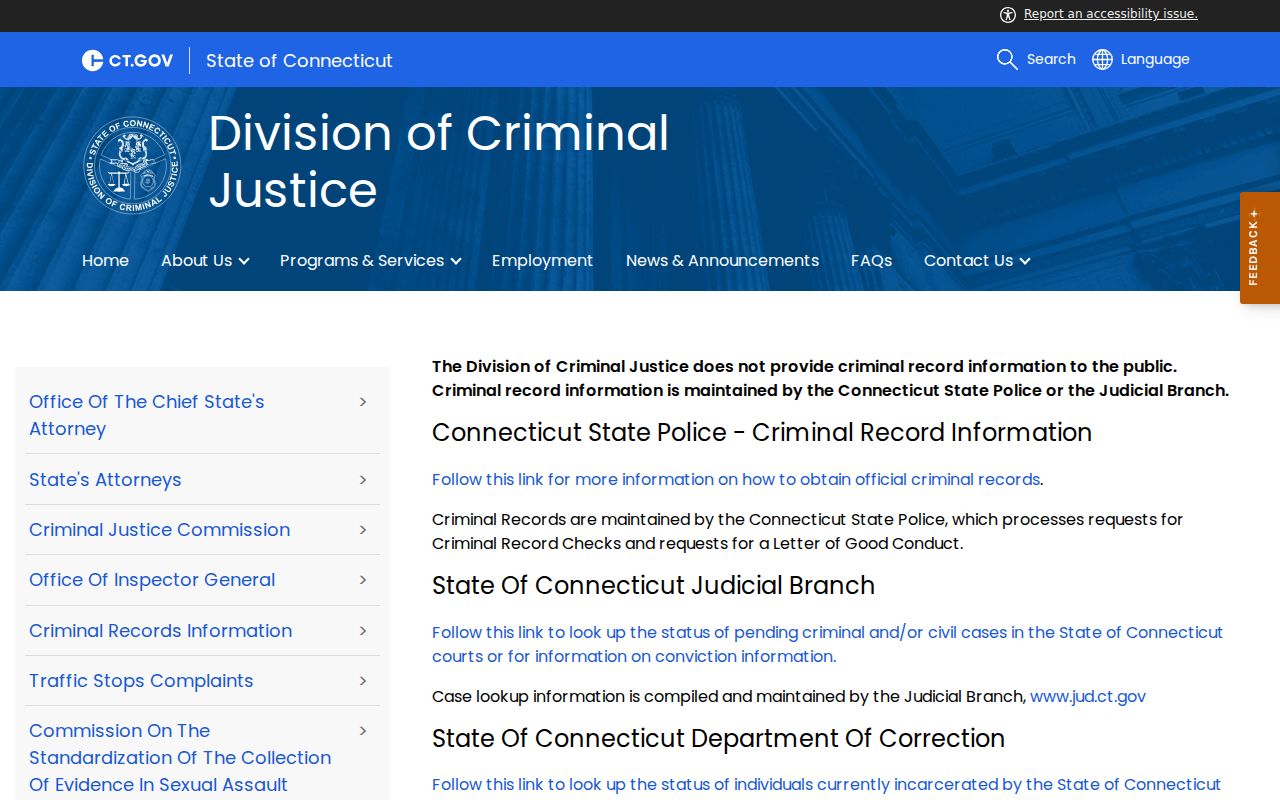
That structure is why Fairfield County searches must move among city and Connecticut offices instead of stopping at a county building.
Official Connecticut Background Checks
The Connecticut Department of Emergency Services and Public Protection, Division of State Police, State Police Bureau of Identification maintains the central repository. Its published form distinguishes a $36 name and date-of-birth existence search from a $75 name-based conviction history. A $75 fingerprint conviction-history search can tie the response to fingerprints, with a separate collection fee.
CCHRS electronic workflows use a service code selected for the request’s authorized purpose. The wrong code can route a result incorrectly or make it unusable for that process. For an individual reviewing their own Fairfield County history, identity certainty matters more than a quick name match. Preserve the response, barcode, receipt, and certified dispositions if a correction is needed.
| Published SPBI option | Amount | What it returns |
|---|---|---|
| Name and DOB existence search | $36 | Whether a Connecticut record exists, not the record itself |
| Name and DOB conviction history | $75 | Connecticut conviction record if one exists; not fingerprint-confirmed |
| Fingerprint conviction history | $75 plus collection | Connecticut conviction result associated through fingerprints |
| DESPP fingerprint service | $15 | Published collection fee when DESPP takes the prints |
Fairfield County CCHRS Request Details
The Connecticut Criminal History Request System supports pre-enrollment for official workflows affecting Fairfield County records.
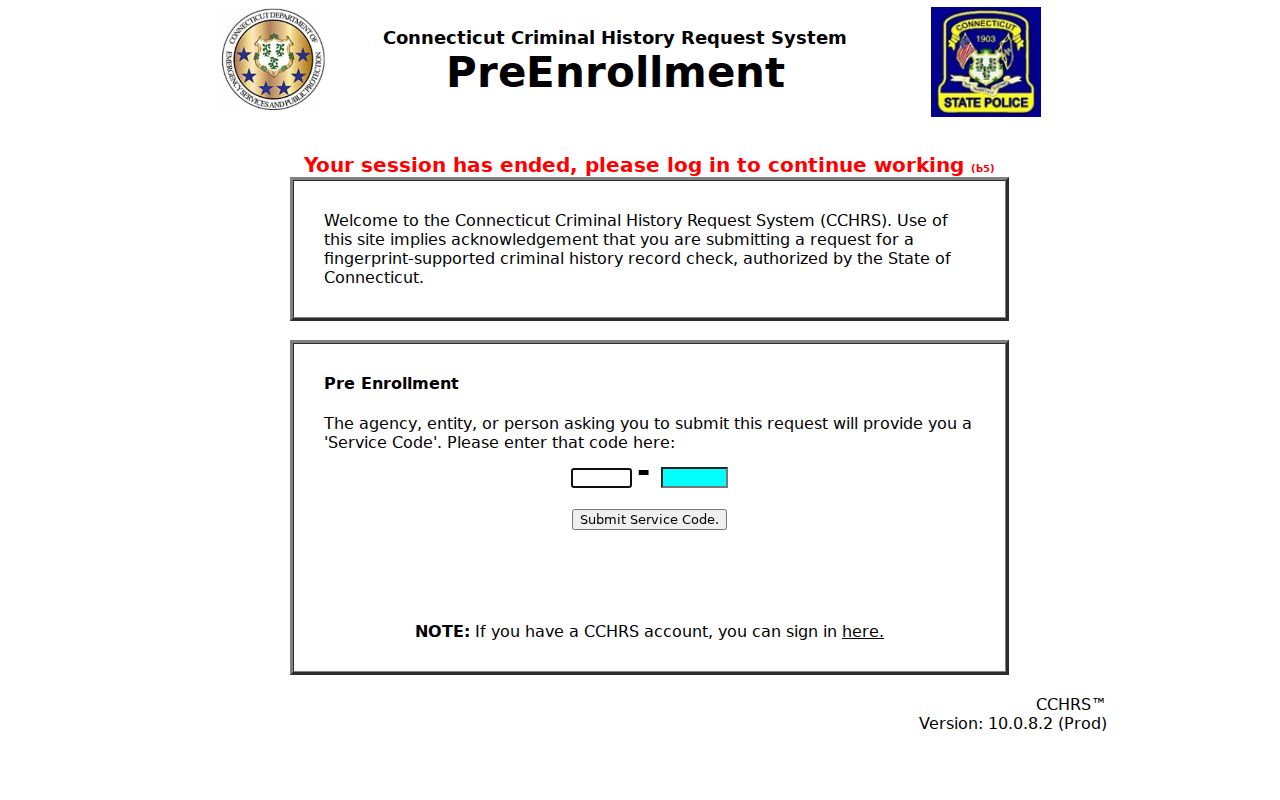
The interface is service-code driven, so read the instructions issued for the specific purpose rather than assuming every CCHRS transaction follows one path.
| Requester fields | Name, date, street address, city, state, ZIP, phone, and optional email on the published mail form |
|---|---|
| Subject fields | Last, first, and middle name, date of birth, plus aliases or maiden names and their dates of birth |
| Fingerprint attachment | Required for the fingerprint search; retain the CCHRS pre-enrollment barcode |
| Payment | Check or money order to Treasurer, State of Connecticut for the mail route; electronic workflows may show other transaction charges |
| Mail destination | DESPP-SPBI, 1111 Country Club Road, Middletown, CT 06457-2389 |
Types of Criminal Records
Fairfield County criminal records are created at different stages. The arresting agency documents the reported event. Superior Court records filed charges and the result. SPBI compiles state conviction history, and DOC reports confinement. Warrants, supervision, and registry entries have their own custodians and access limits.
- Police and arrest records: municipal police or Connecticut State Police describe one agency event and may redact protected detail.
- Criminal case files: Superior Court records charges, appearances, pleas, motions, disposition, and sentence.
- Repository histories: SPBI issues official Connecticut conviction products current as of the response date.
- Custody records: DOC can show accused or sentenced status, location, dates, and the controlling offense.
- Warrant and supervision records: courts, police, Judicial CSSD, DOC, and BOPP each hold only their part.
Fairfield County Court Searches Span Three Hubs
Fairfield County criminal matters do not all route to Bridgeport. Fairfield Judicial District and G.A. 2 serve the Bridgeport area through distinct court locations. Stamford-Norwalk Judicial District and G.A. 1 operate at 123 Hoyt Street in Stamford. Danbury Judicial District and G.A. 3 at 146 White Street serve western and northern towns. The live docket and current Judicial Directory control the assignment.
The Judicial search offers pending cases by defendant or docket, convictions by defendant or docket, daily dockets, arrest warrants, sentence review, and motions to seal. Defendant searches require a last name that “begins with” the entered text and permit a first initial, birth year, year range, court location, and Criminal or Motor Vehicle category. Daily dockets can omit add-on matters, so the assigned clerk remains the fallback when a Fairfield County appearance is too new or does not show online.
For a current case, contact the clerk shown on the docket. For a disposed file in central storage, email SuperiorCourtRecordsCenter@jud.ct.gov or call 860-263-2750 with the case name and docket number. Retrieval is expected in one or two business days. Email can be free when the file size permits; pickup, copies, certification, and identification requirements may apply.
Fairfield Judicial District
1061 Main Street, Bridgeport, CT 06604
203-579-6527
Stamford-Norwalk District
123 Hoyt Street, Stamford, CT 06905
203-965-5307
Danbury G.A. 3
146 White Street, Danbury, CT 06810
203-207-8766
What a Fairfield County Criminal Record Shows
The contents depend on the source. A public docket can display a defendant name, docket number, court, charge, statute, dates, case status, disposition, plea or finding, sentence, bond, and scheduled event. A repository response can connect identifiers, arrest cycles, court tracking, dispositions, and sentences. A DOC profile adds custody details, but that profile is not a certified judgment.
| Name & Identifiers | Legal name, aliases, date of birth, state or inmate number, and fingerprint identity where used |
|---|---|
| Arrest / Booking Data | Agency, date, place, incident number, alleged offenses, bond, and processing details when public |
| Charges & Statutes | Arrest labels may differ from prosecutor-filed charges and any final conviction |
| Disposition | Guilty finding, dismissal, nolle, acquittal, program result, or other recorded outcome |
| Sentence | Incarceration, suspended time, probation, fine, and related court orders when entered |
| Custody / Supervision | DOC accused or sentenced status and location; public probation or parole facts may be limited |
Results can change after correction, erasure, pardon, or modification. Compare the police report, court disposition, and SPBI response rather than treating one old charge label as a permanent Fairfield County outcome.
Fairfield County Custody Uses State DOC
There is no Fairfield County jail, booking agency, or inmate roster. Connecticut DOC is unified and may hold both pretrial accused people and sentenced people. A DOC match can show “Accused (Unsentenced),” so it never proves conviction by itself. A recent municipal arrest may not appear at once, and a brief local processing event may never become a long-term DOC entry.
The statewide search accepts a CT DOC inmate number or surname, with first name and date of birth as narrowing fields. It is updated daily but can lag fast changes. Youthful Offender records and people held for ICE are excluded. For more information, the DOC Public Information Office is available at 860-692-7780 on weekdays from 8 a.m. to 4:30 p.m.
Record flow: Municipal police or Connecticut State Police › Superior Court › Connecticut DOC custody when committed › SPBI disposition history
Public Access Laws
Connecticut FOIA applies to executive-agency records held by municipal police and state agencies. Court files follow Judicial Branch rules and constitutional access principles, so a court request goes to the clerk rather than through an ordinary police FOI process. Public access does not remove exemptions for erased, juvenile, protected-victim, witness, or active investigative material.
Section 1-215 prevents an investigative-record exemption from wiping out the core public fact of an adult arrest. That rule does not open every narrative, recording, witness statement, or image. For a denied Fairfield County police request, preserve the written demand, the response, and the dates. Section 1-206 then provides the Freedom of Information Commission appeal route. A focused request for the nonexempt portion often gives the custodian a clearer task than a demand for every record tied to a name.
Key Statutes:
C.G.S. §1-210 provides access to public agency records while preserving stated exemptions.
C.G.S. §1-212 governs inspection, copies, electronic formats, and lawful copy charges.
C.G.S. §1-215 protects disclosure of the core adult arrest record.
C.G.S. §54-142k addresses availability and dissemination of conviction and nonconviction information.
C.G.S. §54-142l supplies a route to challenge completeness or accuracy.
Fairfield County Police Reports Stay Local
Identify the arresting agency from the court docket, incident number, booking paper, or DOC entry. Bridgeport, Stamford, Norwalk, and other municipal departments each use their own records channels, counter hours, and fees. Request the incident number, date and time, location, precise record or media type, and electronic delivery when available. A court docket may not include the full police narrative, 911 audio, body-camera file, or witness material.
For a Connecticut State Police event, use the DESPP GovQA report route. It requires an account and states a nonrefundable $16 statutory search fee whether or not a report is produced. Card payment and convenience fees may apply. A written denial should cite the exemption, and the requester can ask for all segregable public portions and preserve the dates for a Freedom of Information Commission appeal.
The State Police Bureau of Identification source shows the official agency behind Connecticut criminal-history services used for Fairfield County records.
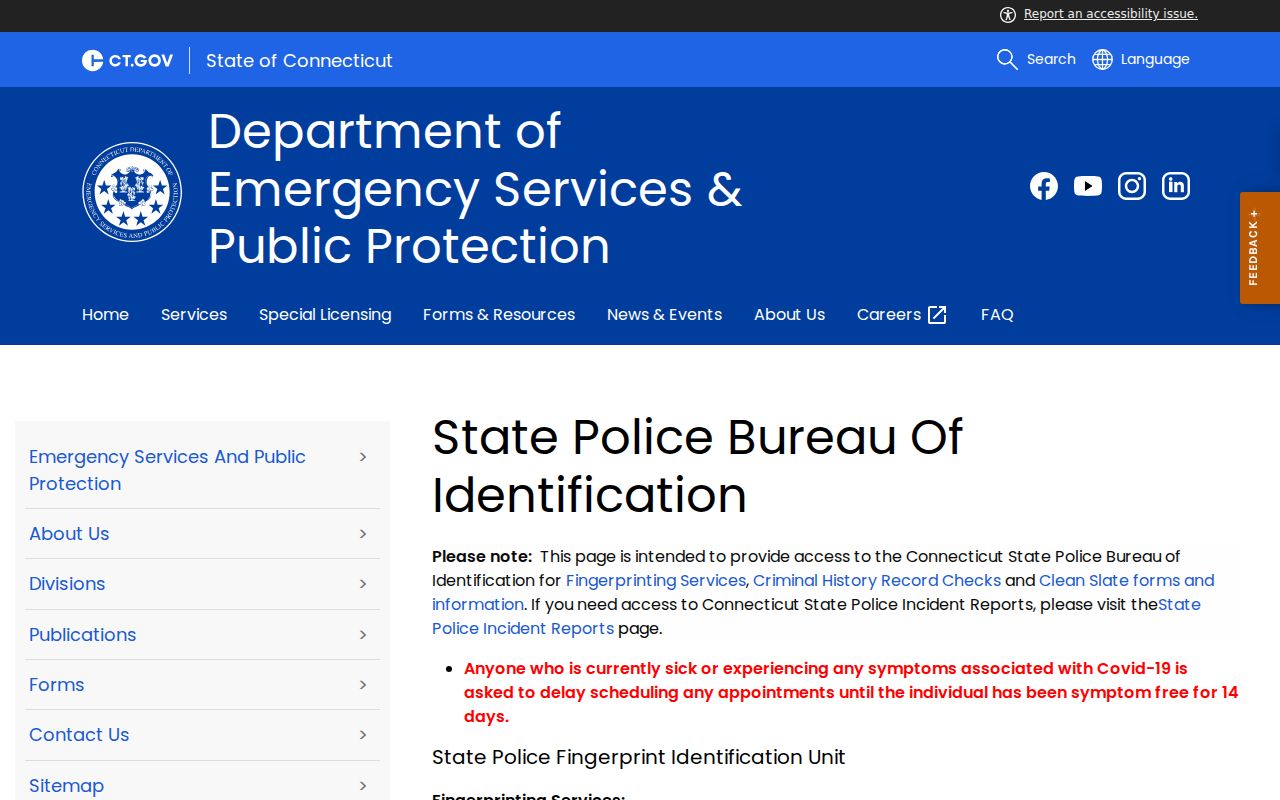
SPBI history requests and police incident-report requests remain different products even when DESPP supports both channels.
Sealed, Expunged & Restricted
Connecticut usually calls the removal of qualifying public records erasure rather than expungement. Section 54-142a covers specified nonconviction outcomes and eligible convictions. Clean Slate automatic erasure applies to qualifying convictions imposed on or after January 1, 2000, while earlier eligible convictions require a petition under the official instructions. Offense, record history, completed sentence, and exclusions control.
A dismissal or acquittal is erased after the appeal period or final appeal, and a nolle ordinarily erases after thirteen months. Form JD-CR-202 addresses qualifying pre-2000 convictions and requires a separate sworn, notarized petition for each case in the court where sentence was imposed, using the successor-court chart if that location closed. Erasure does not by itself end a standing protective order, unpaid fine, or a sex or deadly-weapon registration duty.
The Connecticut Clean Slate record-access source explains how public lookup and official history support review of Fairfield County cases.
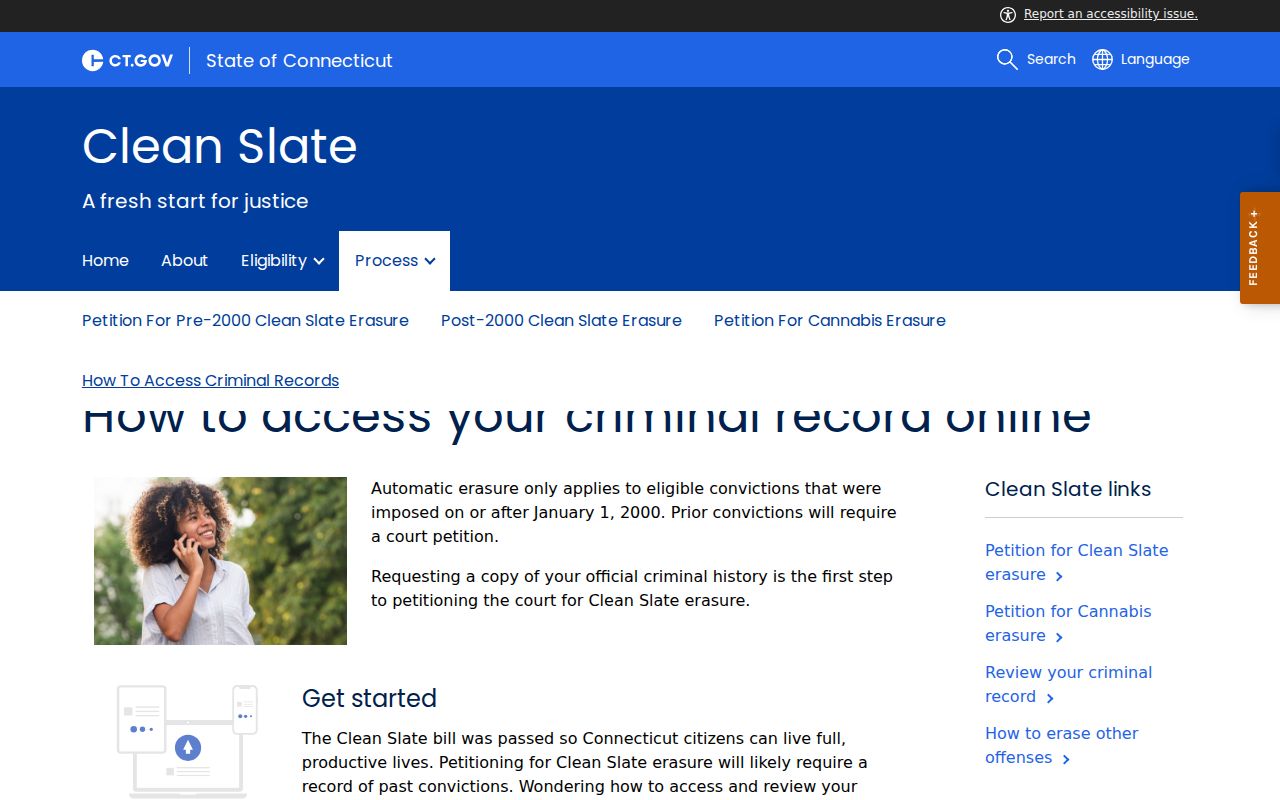
An erased case generally cannot be acknowledged by the clerk. Juvenile and youthful-offender matters follow separate restrictions, and sealed warrants or protected victim information do not become public because another part of an adult case remains visible.
Fairfield County Warrant Searches Need Care
No Fairfield County sheriff warrant database exists. Connecticut warrants issue through Superior Court and are executed by municipal or state law enforcement. Public court data may show a failure-to-appear or capias event, but one web search is not a complete, real-time warrant clearance. Sealed warrants will not appear in ordinary public results.
The safe route is to check the relevant court docket and clerk, then contact the responsible police agency or counsel before appearing. DOC’s fugitive tip line is for tips, not personal warrant confirmation. A blank result should never be presented as proof that a Fairfield County warrant does not exist.
Fairfield County Absolute Pardon Records
An Absolute Pardon through the Connecticut Board of Pardons and Paroles may address records outside Clean Slate routes. BOPP does not charge an application fee, but the required SPBI report and fingerprint collection cost money unless a waiver applies. The criminal-history report generally must be dated within one year of the application.
The official Absolute Pardon FAQ provides the current state process affecting Fairfield County histories.
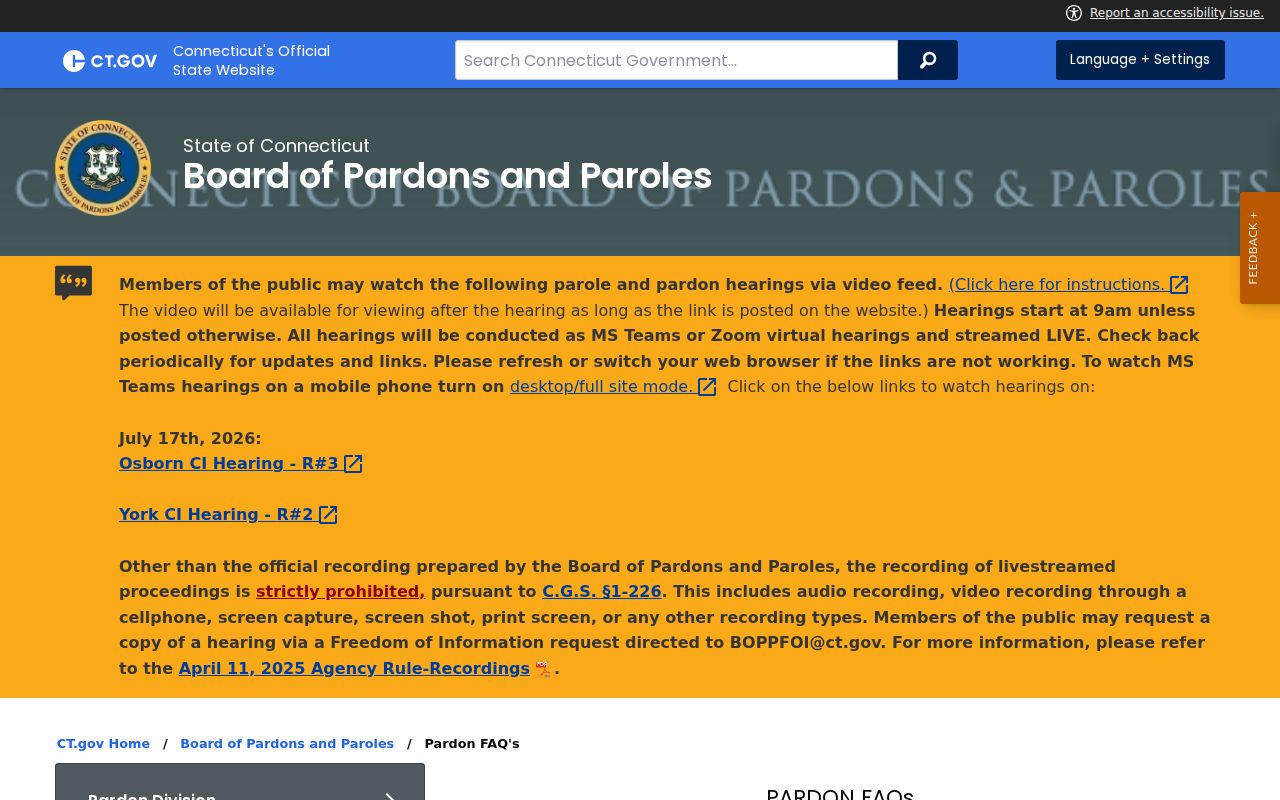
For pardon preparation, BOPP publishes a CCHRS service code, SPBI charge, barcode-retention rule, and local police LiveScan or hard-card steps. Follow that purpose-specific route rather than a general name search.
Criminal Records by City in Fairfield County
Municipal police write their own Fairfield County incident and arrest reports, while criminal court work proceeds in Connecticut Superior Court. The three largest incorporated cities are Bridgeport, Stamford, and Norwalk based on consistent July 1, 2024 Census estimates. Their police records remain local even when the court case, custody record, or conviction history moves into a state system.
Bridgeport Criminal History
151,599 estimated residents · BPD reports are local; current court assignment depends on the matter.
Stamford Criminal History
139,134 estimated residents · Police records stay with Stamford; G.A. 1 and the J.D. sit at Hoyt Street.
Norwalk Criminal History
93,661 estimated residents · NPD reports start at Monroe Street; current criminal matters route to G.A. 1 in Stamford.
Those city routes prevent a common mistake: a police report at one address and a Superior Court file in another city can concern the same Fairfield County event without being duplicate records.